


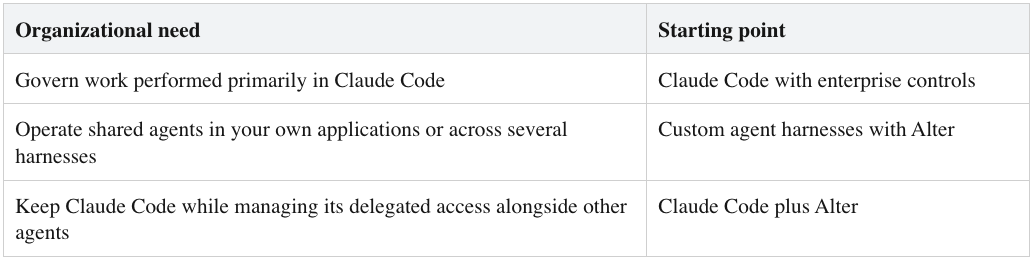
Claude Code’s enterprise controls are a strong starting point for organizations standardizing on Claude Code. If its interface, integrations, and controls fit your workflows, building a custom agent platform may add work without adding much value.
Custom agent harnesses become useful when you want agents inside your own product, shared assistants in a company workspace, or several runtimes serving different teams. Those agents still need governed access to the systems they use. Alter provides a shared way to manage that access on behalf of users.
Choose the harness for the workflow. Add Alter when your organization needs to manage delegated accounts, agent permissions, and access policies across those workflows.
When Claude Code enterprise controls are enough
Suppose your engineering team uses Claude Code to work on repositories, run tests, and query approved internal tools. You want administrators to control which tools are available, restrict execution, and monitor activity. Start with Claude Code’s existing controls.
Administrators can deploy managed settings centrally. Its permission system supports allow, ask, and deny rules, with hooks for additional checks. These rules are enforced by Claude Code itself, independently of the model’s instructions.
Claude Code also supports MCP authentication and OAuth scope restrictions. Its sandbox can restrict filesystem and network access and, with appropriate configuration, mask credentials from sandboxed commands. OpenTelemetry events provide visibility into tool decisions and results.
If your approved connectors already provide the right account permissions, revocation, and audit evidence, that combination may meet your needs. An organization does not need Alter simply because an agent can take actions or because an administrator wants approval rules.
When the workflow calls for a custom agent harness
A custom harness lets your team choose how an agent runs, which tools it uses, and how people interact with it. You might build a shared support assistant in Slack, an invoice-processing workflow inside an internal portal, or a customer-facing agent in your own product.
The organization is now operating an application. That application must authenticate its users, select the correct account for each request, manage background work, and enforce access restrictions throughout the workflow.
OpenClaw, Hermes, and other extensible runtimes can be starting points for those applications. You may also build your own harness. Claude-based tooling can be part of a custom application, too; choosing a custom architecture is not a claim that Claude cannot support the workflow.
The organizational benefit comes from controlling the experience and execution environment your workflow requires. Alter supplies the delegated-access capabilities behind that experience, so each team does not have to implement its own credential broker, grant lifecycle, approval service, and user access dashboard. A single shared agent can benefit from these controls before you operate a larger fleet.
What Alter adds across an organization
An explicit relationship between each user and agent. Users connect accounts and delegate access to named agents. Your integration passes verified user context, and Alter resolves the corresponding grant. Alice’s request uses Alice’s delegation; Bob’s uses Bob’s. One user can give different agents different access and revoke a delegation independently. This is the basis of Alter’s identity model.
Policies that apply across integrated runtimes. Administrators can apply shared restrictions at the organization or application level, then tighten them for particular agents or grants. For example, a company can prohibit email to unapproved domains, and Alice can additionally require approval before sending from her account. All applicable restrictions apply; her approval cannot override the company’s denial. Operation and parameter rules, quotas, time windows, and approval requirements let teams define the access a task needs. Optional AI risk review can add human approval to eligible calls without weakening deterministic rules.
Control for the people whose access is being used. The Alter Wallet is an app-scoped dashboard gated by the application’s identity provider. Users can inspect their connections and activity, add limits, handle applicable approvals, and revoke access. A business user can manage a delegation without navigating the agent host’s configuration or asking the developer to build that interface.
Credential handling that can be shared across harnesses. In proxy mode, provider credentials remain on Alter’s backend and are injected into authorized requests. Each agent uses its own scoped Alter credential. You can apply that arrangement to a shared assistant, a background workflow, and an MCP integration while retaining their separate grants and policies.
An audit record of the authority used. Alter records all calls in immutable, append-only audit logs, with the available user, agent, grant, policy, and outcome context. Updates are blocked at the database layer, and content hashes support integrity checks. Records can be exported or streamed to a SIEM. For proxy calls, the service enforcing access also observes and records execution. The audit documentation explains the recorded fields and visibility rules.
These capabilities are useful when several teams need the same access-management behavior across different agents. You can build equivalent services into your own integrations. Alter gives you an implementation to adopt and operate consistently.
How the controls work for a shared support agent
Consider an organization that already uses Claude Code for engineering and now wants a support assistant inside Slack. The assistant should retrieve customer records, prepare follow-ups, and issue refunds within defined rules. Support representatives will use it through the same application.
Using Alter’s multi-user integration pattern, the workflow can look like this:
Alice signs in through the organization’s identity provider and delegates the relevant account access to the support agent.
When she asks it to act, the integration supplies her verified identity. The agent must have the appropriate delegation before it can use that access.
The administrator’s policy restricts permitted operations and refund amounts. A refund that requires review is held by Alter for the designated approver.
Alter executes the approved provider request through its proxy and records the agent, principal, grant, and outcome.
Alice can review activity and revoke her delegation through the Wallet. Bob’s separate delegation remains available.
Claude Code’s enterprise settings continue governing the engineering team’s Claude Code sessions. The support application needs its own access-management implementation. Alter lets the organization supply that implementation to the support agent and reuse it in other integrated workflows.
The underlying systems still enforce their own permissions. A refund policy cannot give Alice access her account does not have, and database read-only access should remain enforced through native database roles and grants.
Claude Code and Alter can work together
An organization can keep Claude Code as its coding environment and add Alter where delegated provider access needs additional management. Our Claude Code integration guide shows how to build an MCP server that routes provider calls through Alter under a named agent identity.
For example, Alice’s Claude Code integration could receive a restricted Snowflake grant, while her operations assistant receives a separate email grant. The organization manages those delegations through Alter. Claude Code still applies its own tool permissions, and Snowflake still enforces its database privileges.
This is useful when you want a consistent access model across coding agents and business agents without replacing the tools people already use.
What adopting a custom harness involves
Custom harnesses bring operational responsibility. Your team owns the hosting, tool integrations, session isolation, upgrades, and workflow reliability. Alter addresses delegated access; you still need to operate the application and configure its controls correctly.
Our OpenClaw plugin provides an existing integration for user sign-in, delegated accounts, Wallet approvals, activity records, and user-scoped memory tools. It is an early integration. Configure server-side approval policies for any writes that must be held for review.
With Hermes, you can build the connection through its plugin interfaces or MCP support. Your integration must carry verified user context and route the relevant calls through Alter. Other harnesses need suitable extension points and the same identity handling.
Keep each harness’s sandbox and tool restrictions. Alter governs calls routed through it; direct credentials, browser sessions, and unrestricted shell access need separate controls. Memory and session separation also remain application responsibilities, with verified identity available to partition memory.
Start with the organizational requirement
If the goal is to give developers a governed Claude Code environment, start with its enterprise controls and approved integrations. If the goal is to operate agents across users, applications, or harnesses, evaluate how you will manage those agents’ delegated access. That is where Alter becomes useful.
Start with one workflow. Define the agent, the users it represents, and the operations it needs. Test a permitted request, a policy denial, an approval, and revocation. Check that the audit record identifies the authority used at each step.
Try Alter, read the integration docs, or book time with us to work through your organization’s first workflow.