


Several platforms can enforce runtime policies for AI agent actions, including Alter, Amazon Bedrock AgentCore Policy, Permit.io, and agentgateway. Authorization engines such as Cerbos can also provide policy decisions that an application or gateway enforces.
Choosing between them starts with your architecture and the action you need to govern. Restricting which tools an agent can call is one requirement. Controlling what it can do through a connected account, on behalf of a particular user, requires additional context.
At Alter, we focus on that second problem: controlling what agents can access and do through credentials and authority entrusted to them.
What should a runtime policy control?
Runtime policies evaluate a request before the action executes.
For example, an organization might allow an agent to read invoices, require approval before paying them, and prohibit changes to vendor bank details. A user might further restrict the agent to a particular connected account.
These rules need an enforcement point outside the model. The agent proposes an action; the execution layer checks whether it is authorized.
Consider an illustrative invoice workflow:
Proposed actionExpected policy outcomeRead an invoice from an authorized accountAllowPay an eligible $200 invoice within delegated limitsAllowPay a $5,000 invoiceRequire approvalChange the vendor’s bank detailsDenyUse another employee’s account without authorizationDeny
Supporting this workflow requires more than recognizing the name of a payment tool. The enforcement layer needs the relevant identity, account, operation, parameters, and approval state.
Where different platforms enforce policy
Platforms approach this problem from different parts of the execution path.
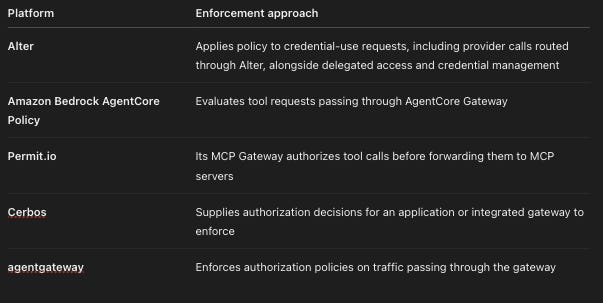
These approaches can overlap. The important question is whether your chosen architecture can enforce the complete rule at the point where the action executes.
Amazon Bedrock AgentCore Policy
AgentCore Policy evaluates requests passing through AgentCore Gateway before allowing tool access. Its documented Cedar policies define which principals can invoke tools and under what conditions. This provides a gateway-level enforcement option for teams building around AgentCore.
Permit.io
Permit MCP Gateway adds authentication, authorization, consent, and audit to MCP tool calls. Allowed calls are forwarded to the MCP server; denied calls return a permission error. It provides an enforcement boundary for agents accessing tools through MCP.
Cerbos
Cerbos evaluates authorization policies, while an application or integrated gateway enforces the resulting decision. Its agentgateway integration supports authorization using information such as user identity, agent roles, tool type, and request context.
agentgateway
agentgateway supports MCP authorization policies expressed in Common Expression Language, or CEL. Policies can govern MCP method invocations and apply different rules to different targets. Teams should verify which request attributes are available during the relevant authorization phase before relying on parameter-level rules.
How Alter combines runtime policy with access control
We built Alter to connect runtime enforcement with the underlying authority to use a credential.
A request needs a valid authorization path before policy is considered. Policies then narrow that access—for example, by restricting an operation or requiring human approval. A policy cannot independently grant access that the caller does not already have.
For agents acting on behalf of users, this connects three decisions:
Whose account may the agent use?
What access has been delegated to this agent?
Is this particular request permitted under the applicable policies?
That distinction matters when the same agent serves multiple people. Sharing an agent should not mean sharing everyone’s credentials or permissions.
Organization policies and end-user limits
Alter supports policies at multiple levels, including the organization, application, provider, agent, and connection. End users can also apply account-level limits through their Wallet. These controls provide ways to establish organization boundaries and further restrict individual access.
For example, an organization could require approval for sensitive operations, while a user adds stricter limits to an assistant’s access to their own account.
Applicable policies are evaluated across the delegation chain, and a denial at any level wins. Removing one restriction does not override another or create a new grant of authority.
Credentials and execution
For provider calls routed through Alter, credentials can remain in Alter’s vault while the agent requests authorized operations. This combines credential protection with a place to evaluate policy before the downstream request.
The integration must preserve that boundary. If an agent can obtain an unrestricted credential or execute the same action through another route, that alternative path needs its own enforcement.
Visibility and revocation
The Wallet gives end users visibility into connected accounts and delegated access, with controls to revoke delegations. Users can also view audit activity concerning their own grants, while administrators have broader application-level visibility.
This helps make delegated access understandable to the person whose account the agent is using.
How to evaluate a platform for your workflow
Start with an actual action from your application and test the entire authorization path.
Can the platform identify both the agent and the relevant user? Can it inspect the operation and parameters your rule depends on? Can it hold a request for approval and prevent execution until approval is granted? Does revocation affect subsequent calls?
Test failure cases as well: a denied request, unavailable policy evaluation, revoked access, changed action details after approval, and an attempted bypass.
The right platform is the one that enforces your required boundaries reliably in your execution architecture.
Get started with runtime policies in Alter
If you are building agents that act through connected accounts, start with one integration and three requests: one that succeeds automatically, one that requires approval, and one that is denied.
Our runtime policy guide explains how to define restrictions, approvals, and other controls. You can try Alter or book a conversation with us to work through your first integration.